|
Is it Anzac or ANZAC?
Is it "Anzac" using lower-case letters or entirely
upper-case "ANZAC"?
Basic advice
In short, use
Anzac, not ANZAC - unless you are specifically
referring to the Australian and New Zealand Army Corps as an
army formation,
ie to the corps itself, in which case use
ANZAC.
For the day of commemoration, use Anzac Day.
|
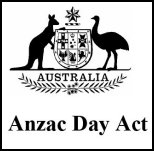
Australian
Government legislation
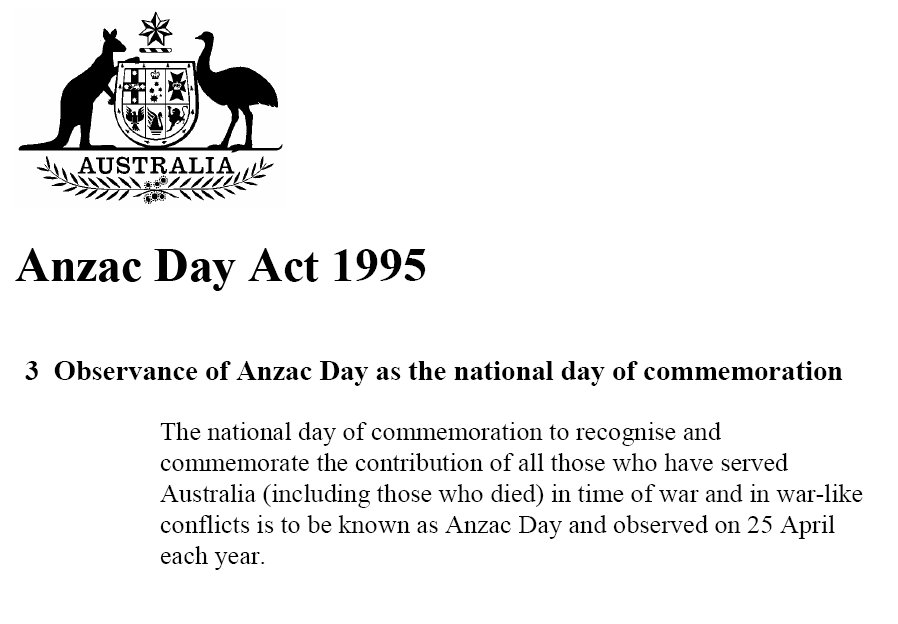
refers to "Anzac Day", not "ANZAC Day" - see
extract or
full Act
[pdf]. However, the legislation in three states (WA, SA and Vic.)
uses "ANZAC Day".
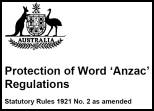
The regulations protecting the word 'Anzac' avoid using the
uppercase term 'ANZAC'.
See the regulations [pdf].
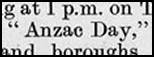
In New Zealand the day was
gazetted in 1916 as "Anzac Day". New Zealand legislation uses
"Anzac Day".
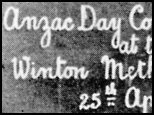
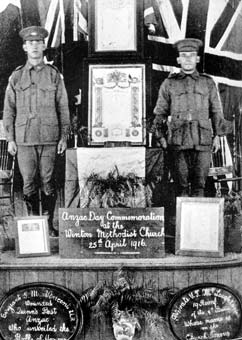
"Anzac Day" using lower case
letters in a United Kingdom church's commemoration notice in 1916 - see
full wording or
photo.
(From anzacs.org.)
|
"Anzac"
"Anzac" is historically the correct way to
write expressions such as "the Anzacs", "an Anzac", "at Anzac", "to Anzac",
"the Anzac sector", "Anzac Cove", "the spirit of Anzac". That is how the
soldiers and those reporting about them in 1915 and 1916 generally wrote the
expressions.
During 1915 the original upper-case acronym "ANZAC" was very soon made into
into the upper- and lower-case "Anzac". In
Use of the
word 'Anzac' - Guidelines [pdf] on the DVA (Department of Veterans' Affairs)
website, the point is made that General William Birdwood requested that the
area held by the ANZAC troops be given the place name 'Anzac'. This word
containing lower-case letters was soon applied to the soldiers themselves
(as 'Anzacs').
Thus, although the expression
"A.&N.Z.A.C." led to the upper-case "ANZAC" becoming the original acronym,
the word "Anzac" with only an upper-case "A" was what was actually used for
locations (Anzac, the Anzac sector, Anzac Cove) and people (the Anzacs,
an Anzac) at
Gallipoli at that time.
The Commander of the
ANZAC troops specifically chose 'Anzac' (with lower-case letters) as
the area name.The soldiers were called Anzacs after the area (Anzac)
they fought and suffered in, not primarily after the corps (ANZAC) they
belonged to.
"ANZAC"
Upper-case ANZAC should be used where the Australian and
New Zealand Army Corps as an army formation or battle grouping is being
referred to, as in "the landing of the ANZAC", "the ANZAC landing", "the
ANZAC forces" or, if the writer has the corps in mind rather than the
soldiers themselves, "the landing of the ANZAC troops".
First Anzac Day
The day of the first Anzac Day commemoration, 25 April
1916, was called "Anzac" Day in honour of the soldiers (the "Anzacs") who
had died since the landing at Gallipoli on 25 April 1915. It was not called "ANZAC" Day, because at that time an upper-case "ANZAC"
Day would have primarily honoured the corps itself rather then the
soldiers. The acronym "Anzac" with "A" the only capital letter was
well-established by then. The soldiers themselves were using "Anzac" as a word
by the time the first Anzac Day was held. They would have regarded the mates
who had died as "Anzacs", not as "ANZACs".
Anzac Day was named after the soldiers (the Anzacs), not after the corps
(ANZAC).
Users of "ANZAC" instead of "Anzac"
However, today there are many people who feel more
comfortable using the upper-case ANZAC for all or some of the expressions,
including the use of "ANZAC Day" instead of "Anzac Day".
Some people feel
very strongly about this, possibly using upper case as a means of showing
respect for the soldiers, or to avoid the appearance of showing disrespect
to New Zealanders (from the "nz" in Anzac being lower case), or to respect the origin of the word "Anzac" itself,
or simply to ensure we never forget the individual words that "ANZAC" stands
for.
As well, in order to achieve the appearance of consistency in their
published material, some people try to avoid using "Anzac" and largely
restrict their use to only the upper-case ANZAC.
The following two organisations appear to have policies
to use the upper-case ANZAC for all or most of the expressions:
- the RSL (Returned and Services League), and
- the ANZAC Day Commemoration Committee of Queensland (anzacday.org.au).
As you are likely to access at least some of the material
available on their websites you need to be aware that they have chosen to
prefer "ANZAC" over "Anzac". A third organisation, the Australian War Memorial,
used to prefer ANZAC to Anzac for all expressions but it has now reverted to
the standard use of "Anzac", with "ANZAC" being used only for the corps
itself.
In recent years, when the parliaments of three State governments changed
their laws about Anzac Day they specified the use of "ANZAC" instead of
the historically correct "Anzac". However,
the Australian Government's legislation correctly refers to the day as "Anzac Day", not
as "ANZAC Day".
It is common for the upper-case ANZAC to be used in teaching primary school
students about Anzac Day and the Anzacs because this is an effective way to
help young
students learn the words the letters in the acronyym stand for. However, in later years
many students miss out on a more detailed study of the Gallipoli campaign
that would allow them to learn the historically correct way of writing the
expressions. Thus, a large proportion of Australians would have been taught
at school only to use capitals, as in "ANZAC Day" and "the
ANZACs".
Adding to the confusion, the publishers of many books on the Anzac soldiers
and Anzac Day have used upper case for the whole of their titles, perhaps to
avoid the issue of distinguishing between Anzac and ANZAC.
Some organisations and people have made up their own rules; for example,
some write "Anzac Day" using lower case but "the ANZACs" with upper case,
while others write "ANZAC Day" with upper case but "the Anzacs" with lower
case. And there is much published material in which the same author uses
Anzac and ANZAC interchangeably for the same expression, suggesting that
many people feel that it is not essential to adhere strictly to the rules,
or are unaware of any rules or are having an each-way bet.
Quoting
If you are referring to a publication whose title uses
ANZAC or Anzac, then quote the title exactly the same way as it is written on the title
page of the publication. (And ignore the way the designer has presented it
on the cover.) Similarly, if you quote someone's published words
containing Anzac or ANZAC, quote the words the way they have been published,
even if you believe they have not been used in the historically correct way.
Essays
If you are a student writing an essay and you are
concerned about an appearance of inconsistency resulting from some of your
words and quotes using Anzac while others use ANZAC, then it might be worth
providing a footnote or making a statement at the beginning or end of your
essay to explain the mixture. You could also use paraphrasing or partial
quotes to avoid using the word within a quote when the author has used it
incorrectly. It might be advisable to seek
your teacher's view on the use of Anzac and ANZAC, particularly if you are
writing an essay for an audience that includes people who prefer to use
ANZAC over Anzac.
Conclusion
From 1916 onwards, the main purpose of
holding Anzac Day has been to acknowledge the sacrifice of the individual
soldiers who have died. Anzac Day was not introduced primarily to pay tribute
to the Australian and New Zealand Army Corps itself. The occasion was
therefore called Anzac Day, not ANZAC Day.
For students of history, your main purpose
in writing will normally be to demonstrate your understanding of history,
making the historically accurate word "Anzac" the appropriate word to use
when referring to Anzac Day, the soldiers and the locations at Gallipoli,
and upper-case ANZAC the appropriate term only for the army formation
itself. However, you need to be aware that there is much uncertainty in the
community over the use of Anzac and ANZAC, and also that a general use of
the upper-case ANZAC is preferred by many people with a different main goal
in writing, such as ensuring the origin of the term is never forgotten.
More information
For more information, see:
-
Use of the
word Anzac - Guidelines [pdf] (Department of Veterans' Affairs).
-
Anzac Day 2024 – Traditions and rituals on Anzac Day: a quick guide (Parliamentary Library) - scroll down to "Is it Anzac
Day or ANZAC Day?"
-
Frequently Asked Questions (anzacs.org).
- "ANZAC or Anzac?" in
Gallipoli and the Anzacs - Unit 3 The landings at Gallipoli 25 April 1915
[pdf], page 33 (Department of
Veterans' Affairs).
-
The word
"Anzac" [doc] (archived from reocities.com), by Bruce Topperwien.
May need to be downloaded before opening. (See document for publication details.)
-
ANZAC
acronym, Australian War Memorial
-
Anzac
spirit - the word "Anzac", Australian War Memorial
-
Use of the word 'Anzac'
guidelines, Manatu Taonga, the Ministry for
Culture and Heritage, New Zealand Government.
Updated 26 April 2025 |




 To Anzac Day Websites main page